
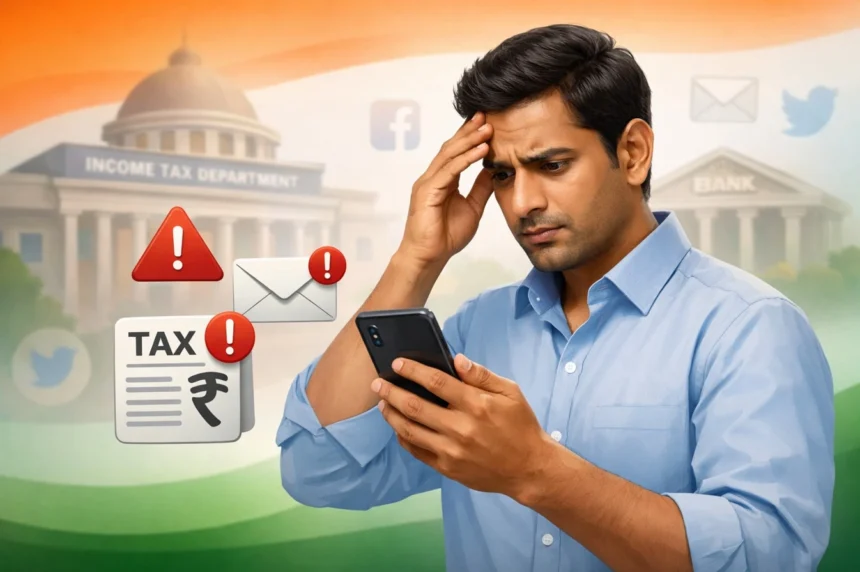
In recent days, social media platforms have been flooded with alarming posts claiming that the Income Tax Department will gain access to citizens’ bank accounts, emails, and even social media accounts starting April 1. These claims are being linked to the proposed Income Tax Act, 2025, leading to widespread confusion and fear among taxpayers across the country.
Many users began believing that the government is introducing mass digital surveillance under the new tax law. However, the reality is very different from what is being circulated online.
What Is the Viral Claim About Income Tax Act 2025?
According to the viral posts, the Income Tax Department will allegedly have the legal right to monitor bank transactions, read emails, and check social media activity of taxpayers to curb tax evasion. Some posts even suggested that this would apply to all citizens, regardless of whether they are under investigation or not.
These claims spread rapidly, especially because financial privacy and digital freedom are highly sensitive topics. As a result, many people feared that the new Income Tax Act would violate their right to privacy.
Modi Government Issues Official Clarification
To counter the misinformation, the Modi government issued a clear clarification through PIB Fact Check, the official fact-checking unit of the Press Information Bureau. In a post on social media platform X (formerly Twitter), PIB Fact Check labelled the claims as “misleading”.
According to the official clarification, the Income Tax Department will not have blanket powers to access bank accounts, emails, or social media platforms of ordinary citizens under the Income Tax Act 2025.
For More Info Visit : https://www.pib.gov.in
Understanding Section 247 of the Income Tax Act, 2025
The confusion mainly arises from Section 247 of the Income Tax Act, 2025. The government explained that this provision is strictly limited in scope and purpose.
Section 247 applies only during search and survey operations. These operations are conducted only when tax authorities have credible evidence of large-scale tax evasion or black money. It does not give general monitoring rights to the Income Tax Department.
Importantly, the government clarified that these powers:
- Cannot be used for routine information collection
- Cannot be applied during normal investigations
- Cannot be used on law-abiding taxpayers
This means that unless a person is involved in serious financial wrongdoing backed by evidence, their digital and financial data remains private.
No Mass Surveillance, No Routine Monitoring
The government has categorically stated that the Income Tax Act 2025 does not allow mass surveillance of citizens. Emails, bank details, and social media activity cannot be accessed randomly or for regular scrutiny.
These provisions are designed only to fight black money and major tax fraud, not to invade the privacy of honest taxpayers. The clarification aims to reassure citizens that their fundamental right to privacy remains protected.
Also read this : UPI X Lite: Make Seamless UPI Payments Up to ₹1,000 Even Without Internet
PIB Fact Check’s Final Verdict
PIB Fact Check urged citizens to avoid believing unverified social media claims and to rely only on official government notifications. It reiterated that misleading interpretations of legal provisions often cause unnecessary panic.
The government also warned against spreading half-truths and misinformation related to taxation laws, especially when such claims can damage public trust.
Should Ordinary Taxpayers Be Worried?
The simple answer is No. If you are a law-abiding taxpayer who files returns honestly, there is no reason to worry. The Income Tax Department does not have the authority to check your emails, social media accounts, or bank details without due legal process and strong evidence.
The Income Tax Act 2025 does not change the privacy framework for ordinary citizens. Instead, it strengthens enforcement against serious offenders involved in large-scale tax evasion.
The viral claim that the Income Tax Department will access bank accounts, emails, and social media from April 1 under the Income Tax Act 2025 is false and misleading. The government has officially clarified that such powers are limited only to search and survey cases involving substantial tax evasion.
Citizens are advised to stay informed through reliable sources and avoid panic based on social media rumours.