The year 2026 is shaping up to be a turning point for Indian Railways. After decades of gradual improvements, the railway network is now entering a phase where speed, safety, and passenger comfort are becoming top priorities. With multiple routes approved for 160 kmph operation and ambitious plans for 200 kmph corridors, India is steadily moving closer to global rail standards. This railway speed upgrade is not just about faster trains; it reflects a larger transformation in infrastructure, signalling systems, and travel experience for millions of passengers.
Understanding the Railway Speed Upgrade Plan for 2026
Indian Railways has traditionally operated most passenger trains at speeds between 100 and 130 kmph. However, increasing passenger demand, competition from air travel, and the need for efficient intercity connectivity have pushed the railways to rethink this approach. Under the 2026 upgrade plan, several high-density routes are being modernized to safely support semi-high-speed and high-speed operations.
The focus is on strengthening tracks, eliminating level crossings, installing modern signalling systems, and deploying advanced safety technologies. These changes allow trains to maintain higher speeds consistently without compromising safety.
Also read this : Guaranteed & Powerful Guide to Train Ticket Refund Rules 2026: Save Money the Smart Way
Routes Approved for 160 kmph Speed in India
Several routes across the country have already been approved or upgraded for 160 kmph operations. These sections have undergone extensive trials and safety inspections before being cleared for higher speeds.
The Delhi–Agra–Jhansi corridor was among the first in India to achieve 160 kmph readiness. This route demonstrated that existing railway infrastructure could be successfully upgraded with the right technology and planning. Following this success, sections of the Delhi–Mumbai route, particularly Kota–Nagda and Vadodara–Surat, have been prepared for higher speeds.
In eastern India, parts of the Delhi–Howrah route have also seen significant upgrades. Similarly, the Chennai–Bengaluru–Mysuru corridor in the south has emerged as one of the smoothest semi-high-speed routes, offering reduced travel time and improved ride quality.
Which Trains Are Running at 160 kmph in 2026?
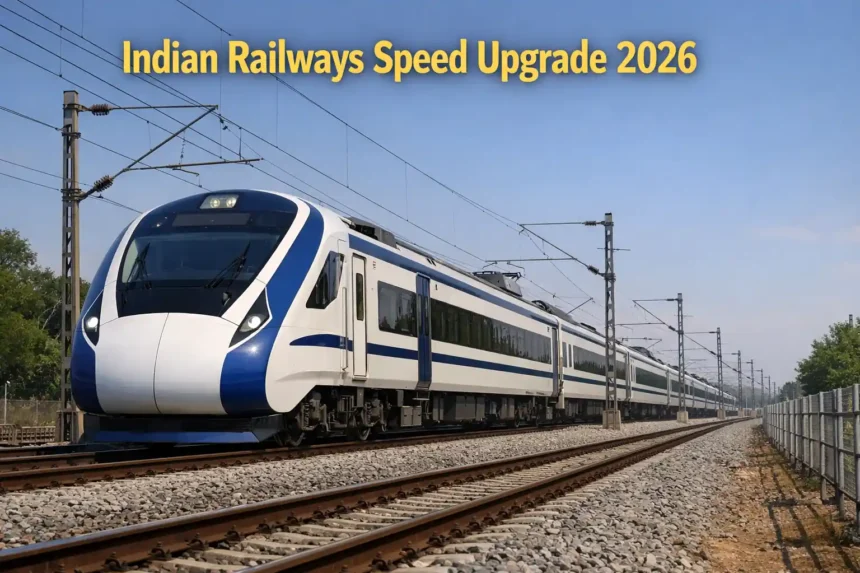
Not all trains are designed to operate at such high speeds. Currently, premium and modern trains are given priority on upgraded routes. The most notable among them is the Vande Bharat Express, which has become the face of India’s semi-high-speed rail movement. These trains are equipped with advanced braking systems, better suspension, and aerodynamically efficient designs.
Selected Rajdhani and Shatabdi trains have also been upgraded to operate at speeds close to 160 kmph on suitable sections. However, their actual running speed depends on route conditions, traffic density, and signalling compatibility.
160 kmph Speed Available Sections in India (As of 2026)
| No. | Railway Route | Section with 160 kmph Permission | Major Trains Using This Speed | Zone |
|---|---|---|---|---|
| 1 | Delhi – Agra – Jhansi | Tughlakabad – Agra Cantt – Jhansi | Vande Bharat Express | North Central Railway |
| 2 | Delhi – Mumbai | Kota – Nagda | Vande Bharat, Rajdhani | West Central / WR |
| 3 | Delhi – Mumbai | Vadodara – Surat | Vande Bharat | Western Railway |
| 4 | Delhi – Howrah | Kanpur – Prayagraj – DDU | Vande Bharat (selected) | North Central / ECR |
| 5 | Chennai – Mysuru | Chennai – Bengaluru – Mysuru | Vande Bharat Express | Southern Railway |
| 6 | Mumbai – Ahmedabad | Mumbai Central – Ahmedabad (selected stretches) | Vande Bharat | Western Railway |
| 7 | Delhi – Chandigarh | Delhi – Ambala (trial & selective) | Vande Bharat | Northern Railway |
| 8 | Secunderabad – Tirupati | Lingampalli – Renigunta (parts) | Vande Bharat | South Central Railway |
Important Notes (Must Read)
- 160 kmph is NOT for the entire route, only for specific upgraded sections
- Speed depends on:
- Track class
- Signalling system
- Kavach safety availability
- Only premium trains (mainly Vande Bharat) are allowed this speed
- Conventional trains usually run at 130–140 kmph even on these routes
Which Trains Actually Touch 160 kmph?
| Train Type | Max Permitted Speed |
|---|---|
| Vande Bharat Express | 160 kmph |
| Rajdhani (upgraded) | Up to 160 kmph |
| Shatabdi (selected) | 150–160 kmph |
Are 200 kmph Trains Running in India Yet?
As of 2026, commercial train operations at 200 kmph have not started in India. However, preparations are well underway. Dedicated passenger corridors on high-density routes like Delhi–Mumbai and Howrah–Chennai are being planned with future 200 kmph operations in mind. These corridors require stricter safety norms, advanced fencing, and complete separation from freight traffic.
The introduction of trains capable of running at 200 kmph will likely begin with premium services, ensuring that operational experience and safety benchmarks are firmly established before wider deployment.
Infrastructure and Safety Changes Behind High-Speed Trains
Achieving higher speeds is not just about faster locomotives or coaches. Indian Railways has invested heavily in infrastructure upgrades to support these changes. Tracks are being reinforced, curves are being realigned, and platforms are being straightened to reduce speed restrictions.
One of the most significant developments is the introduction of the Kavach automatic train protection system. This technology helps prevent collisions and overspeeding, making high-speed operations safer. Modern electronic interlocking and signalling systems also play a crucial role in managing train movements efficiently.
How Passengers Benefit from the Speed Upgrade
For passengers, the benefits of the railway speed upgrade are immediate and tangible. Faster trains mean shorter travel times, making same-day intercity travel more convenient. Improved track quality and modern coaches also result in smoother rides with less vibration and noise.
Higher speeds often come with better punctuality, as upgraded routes are designed to handle traffic more efficiently. While ticket prices for premium trains may be slightly higher, the time saved and comfort offered make them an attractive option for many travelers.
Also read this : RAC, WL & GNWL Explained in Simple Language: Indian Railways Booking Rules 2026
Future Vision of Indian Railways Beyond 2026
The speed upgrade initiative is part of a broader vision to modernize Indian Railways. Semi-high-speed trains are expected to connect most major cities in the coming years, while high-speed rail projects continue to progress. The long-term goal is to create a balanced transport system where railways offer a viable alternative to short-haul flights.
Organizations like Indian Railways and National High Speed Rail Corporation are working together to ensure that India’s rail network is future-ready, safe, and globally competitive.
For official updates and passenger-related information, travelers can always refer to the authoritative website of IRCTC.
Speed with Safety Is the Real Achievement
The Indian Railways speed upgrade of 2026 marks a significant milestone in the country’s transportation journey. While 160 kmph operations are already a reality on several routes, the roadmap towards 200 kmph trains shows clear intent and direction. More than just speed, this transformation focuses on safety, reliability, and passenger satisfaction. As infrastructure upgrades continue, Indian Railways is steadily redefining how long-distance travel is experienced in the country.