AI vs Human Jobs in India 2026 – A Real Concern?
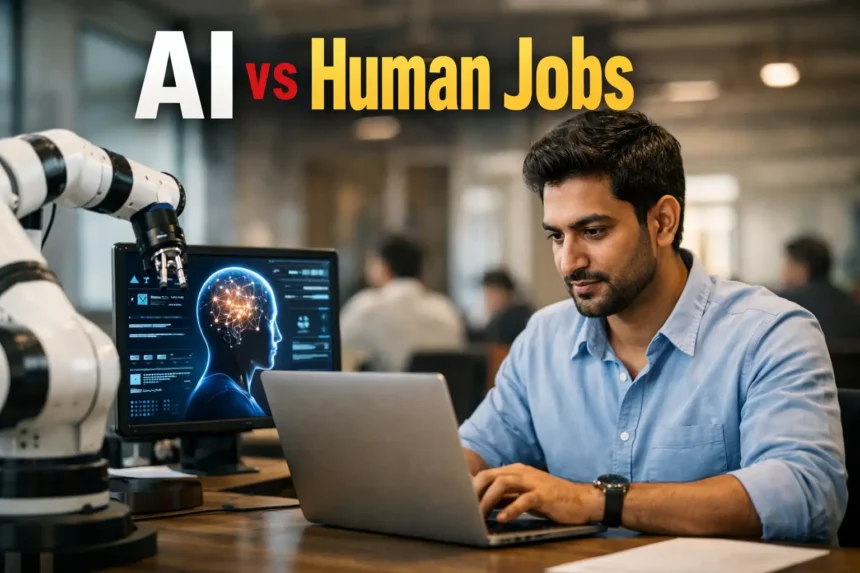
The debate around AI vs human jobs in India 2026 is no longer theoretical. Artificial intelligence has moved beyond experiments and is now deeply integrated into offices, startups, factories, and even small businesses. From automated customer support to AI-driven content creation, technology is reshaping the employment landscape at an unprecedented speed. For middle-class employees, students, and job seekers, the big question is clear: Are jobs at risk due to AI? Or will AI create more opportunities than it destroys? The answer lies somewhere in between.
In this blog, we explore how AI automation in India is impacting employment, which sectors are vulnerable, and how individuals can secure their future in this changing environment.
The Rapid Growth of AI Automation in India
India has quickly adopted artificial intelligence across industries such as banking, IT services, healthcare, education, and e-commerce. Businesses are using AI tools to analyze data, automate repetitive tasks, improve efficiency, and reduce operational costs.
According to global employment outlook discussions by organizations like the World Economic Forum, automation and AI are expected to transform millions of jobs worldwide. While some roles may disappear, new skill-based roles are emerging simultaneously. The impact of AI on employment in 2026 is not about total job loss, but about job transformation.
Jobs Most at Risk Due to AI in 2026
Repetitive and Data-Entry Roles
Jobs that involve repetitive tasks are the most vulnerable. Data entry operators, basic accounting clerks, and tele-calling executives are already seeing automation tools replace manual effort. AI systems can process large volumes of data faster and with fewer errors.
Basic Customer Support
AI chatbots are now capable of handling common queries 24/7. Many companies are reducing human support teams and relying on automated systems for first-level interaction. While complex queries still require human intervention, entry-level roles are shrinking.
Routine Content Creation
Basic content writing, simple translations, and standard report generation are increasingly supported by AI tools. Professionals who rely only on basic skills without adding creativity or strategy may face difficulty.
Jobs That Are Growing Because of AI
Interestingly, the AI vs human jobs debate also reveals positive growth areas.
AI Specialists and Data Analysts
Demand for AI engineers, data analysts, and machine learning professionals is increasing. Companies need skilled individuals who can build, manage, and improve AI systems.
Creative and Strategic Roles
Creativity, emotional intelligence, leadership, and strategic thinking remain difficult for AI to replicate. Marketing strategists, brand managers, legal experts, psychologists, and creative designers are adapting AI as a tool rather than seeing it as competition.
Skilled Trades and Field Jobs
Electricians, healthcare workers, technicians, and on-ground service providers are relatively safer from automation. Physical presence and human judgment remain essential in these roles.
Skills Safe from AI in 2026
If you are worried about job security in 2026 India, focus on developing skills that complement AI rather than compete with it. Critical thinking, problem-solving, communication, adaptability, and digital literacy are becoming essential. Instead of resisting technology, employees should learn how to use AI tools to improve productivity.
For example, marketing professionals who use AI for analytics gain better insights. Writers who use AI for research save time. Accountants who adopt automation tools increase accuracy. The future belongs to those who collaborate with AI.
Also read this : Proven Ways to Earn Money Using AI in 2026: Ultimate Guide for Students & Freelancers
How Middle-Class Employees Can Future-Proof Their Career
The reality of AI impact on employment in 2026 means continuous learning is no longer optional. Online certification courses, practical skill development, and exposure to digital tools are essential.
Diversifying income sources can also reduce risk. Many professionals are exploring freelancing, consulting, or online income opportunities alongside traditional jobs. This hybrid approach provides financial stability in uncertain times. Networking and staying updated with industry trends can also make a difference. Those who anticipate change early often benefit the most.
The Psychological Impact of AI Fear
Fear of losing jobs due to AI is widespread. Social media often exaggerates threats, creating panic among young professionals. However, history shows that every technological revolution—from industrial machines to computers—initially caused fear but eventually created new employment sectors. The key is mindset. Viewing AI as a powerful tool rather than an enemy changes the approach completely.
AI vs Human Jobs in India 2026 – Adaptation Is the Key
The discussion around AI vs human jobs in India 2026 is complex but not hopeless. Yes, certain repetitive jobs are at risk due to AI. However, artificial intelligence is also creating new career paths and increasing efficiency across industries.
Employees who continuously upgrade their skills, embrace technology, and develop human-centric abilities will remain relevant. AI is not replacing humans entirely; it is replacing outdated skills. The future of jobs in India depends on adaptability. In 2026 and beyond, those who learn to work with AI instead of against it will build stronger and more secure careers.