
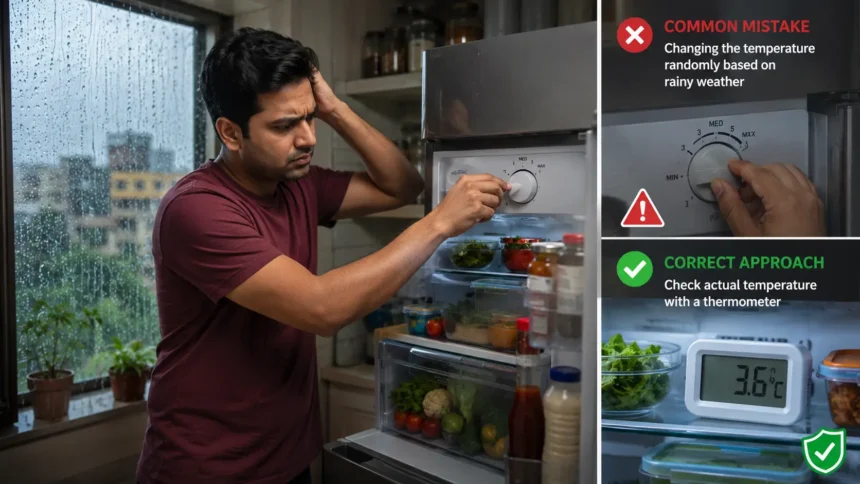
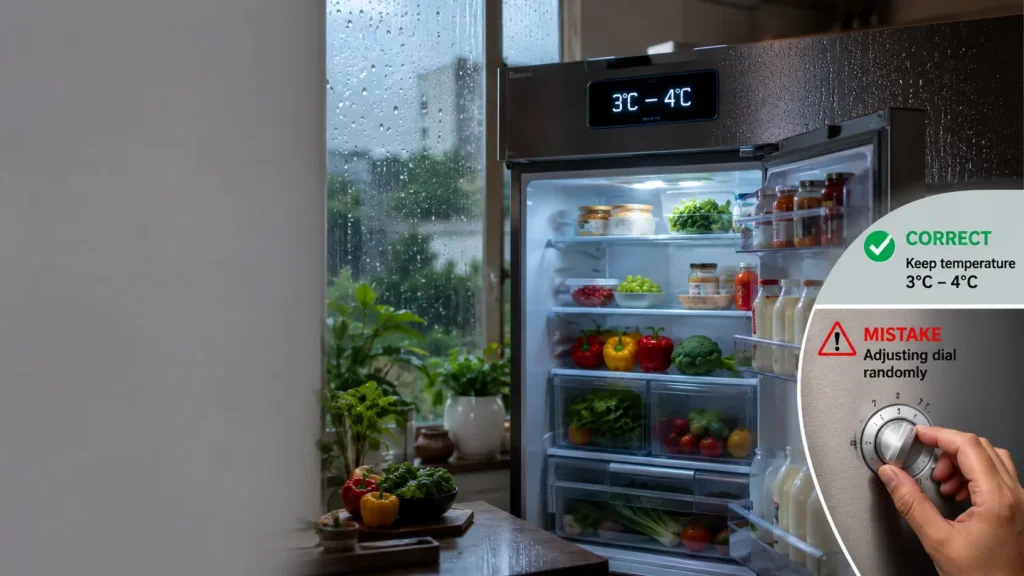
Monsoon brings relief from summer heat, but it also creates confusion about refrigerator settings. Many people increase or decrease cooling according to rain, humidity, or outdoor temperature.However, changing refrigerator settings based only on weather is not the right approach.
- Quick Answer
- Recommended Refrigerator Temperature During Monsoon
- The Biggest Refrigerator Mistake During Monsoon
- What Fridge Dial Number Should You Use During Monsoon years ?
- Why Monsoon Weather Can Increase Refrigerator Cooling Load
- Does Monsoon Humidity Make Food Spoil Faster ?
- How to Keep Food Fresh During Monsoon
- Where Should You Place a Refrigerator Thermometer ?
- What to Do If Your Refrigerator Temperature Is Above 4°C
- Freezer Temperature During Monsoon
- How to Reduce Refrigerator Electricity Consumption During Monsoon
- Common Refrigerator Mistakes to Avoid During Monsoon
- When Should You Call a Refrigerator Technician ?
- Frequently Asked Questions
The best refrigerator temperature during monsoon is around 3°C to 4°C (37°F to 40°F) for practical household use, while the refrigerator should remain at or below 4°C (40°F). The freezer should be maintained at -18°C (0°F).
You generally do not need a special refrigerator setting for the rainy season. What matters is maintaining a stable internal temperature, storing food correctly, limiting the entry of warm and humid air, and checking the actual temperature with an appliance thermometer.
Quick Answer
The best refrigerator temperature during monsoon is around 3°C to 4°C (37°F to 40°F), while the freezer should remain at -18°C (0°F).Do not automatically change the thermostat because of rain or humidity. Use an appliance thermometer to check the actual temperature and adjust the controls only when necessary.
Recommended Refrigerator Temperature During Monsoon
Food safety temperature recommendations do not change simply because monsoon has started.
The U.S. Food and Drug Administration (FDA) recommends keeping refrigerators at or below 40°F (4°C) and freezers at 0°F (-18°C).
For everyday household use, targeting approximately 3°C to 4°C provides a practical safety margin while reducing the risk of unnecessary overcooling.
| Refrigerator Area | Recommended Temperature | Practical Advice |
|---|---|---|
| Refrigerator compartment | Around 3°C to 4°C | Maintain a stable temperature and verify it periodically |
| Freezer | -18°C (0°F) | Seasonal adjustment is generally unnecessary |
| Refrigerator door | Usually warmer than interior shelves | Avoid storing highly perishable foods here |
| Middle shelf | Practical location for a thermometer | Keep it away from walls and direct cold-air vents |
Keeping perishable food properly refrigerated is important throughout the year. According to food safety guidance, bacteria can multiply rapidly when perishable foods remain within the temperature “Danger Zone” of approximately 4°C to 60°C (40°F to 140°F).
The Biggest Refrigerator Mistake During Monsoon
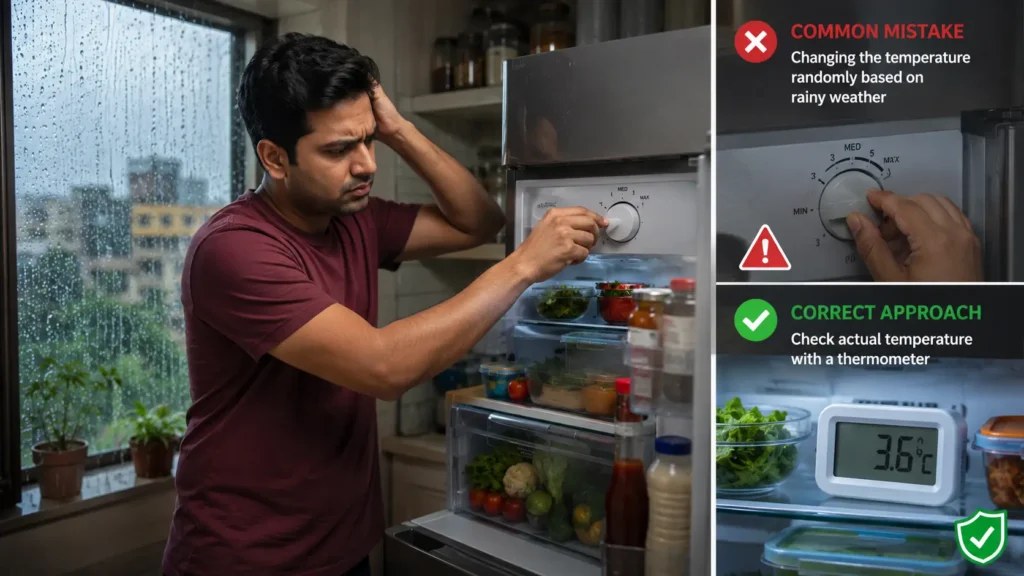
The most common mistake is changing the refrigerator thermostat according to outdoor weather without checking the actual temperature inside the appliance.Some people reduce cooling because rainy weather feels cooler. Others set the refrigerator to maximum cooling because they believe high humidity requires stronger refrigeration. Neither approach is reliable without an actual temperature reading.
A properly functioning refrigerator is designed to maintain safe internal conditions despite normal changes in room temperature and humidity.Your goal should be simple: check the actual internal temperature and adjust the thermostat only when necessary.Another important point is that refrigerator dial numbers are not standardized.
On many models, a higher dial number means stronger cooling. However, thermostat scales and cooling systems vary between manufacturers.A setting of “3” on one refrigerator may produce a different temperature from the same setting on another appliance.Always check the refrigerator’s user manual and use an appliance thermometer instead of relying only on dial numbers.
What Fridge Dial Number Should You Use During Monsoon years ?
There is no universal fridge dial number that works for every refrigerator during monsoon.Thermostat scales, digital controls, cooling technologies, convertible modes, and recommended settings vary between models.Instead of choosing a fixed number from 1 to 5, follow these steps:
- Check the refrigerator’s user manual.
- Place an appliance thermometer inside the refrigerator.
- Allow sufficient time for the temperature to stabilize.
- Check whether the refrigerator remains at or below 4°C.
- Adjust the thermostat gradually only when required.
This method is more reliable than choosing a dial number according to outside weather.
More Read

Why Monsoon Weather Can Increase Refrigerator Cooling Load
Monsoon weather often brings higher humidity. Whenever the refrigerator door is opened, warm and humid room air can enter the appliance. The refrigerator must remove the additional heat and moisture while restoring its target internal temperature. Frequent or prolonged door opening can therefore increase the cooling load.
A dirty, damaged, or poorly sealing refrigerator door gasket can make the problem worse by allowing room air to enter continuously.Possible signs of a door seal problem include excessive condensation, unusually frequent compressor operation, difficulty maintaining a stable temperature, and visible cracks or gaps in the rubber gasket.High humidity alone does not mean you should automatically increase refrigerator cooling.Check the internal temperature, door seal, airflow, and food loading before changing the thermostat.
Does Monsoon Humidity Make Food Spoil Faster ?
Humidity can influence food quality and spoilage conditions, but monsoon weather does not automatically make all refrigerated food spoil faster.Food spoilage depends on several factors, including temperature, moisture, food composition, packaging, contamination, and storage conditions.
Warm and humid conditions may encourage mould growth on certain foods when they are exposed to excess moisture or stored improperly.However, a properly functioning refrigerator maintained at a safe temperature should continue protecting food during monsoon.
The bigger practical concerns are leaving perishable foods at room temperature for too long, storing wet produce improperly, frequently opening the refrigerator door, blocking cold-air vents, cross-contamination, and using an appliance with a damaged door seal.
Also read : Delicious & Energizing Lajardraka Recipe – Puffed Paddy Ginger Granules-2026
How to Keep Food Fresh During Monsoon
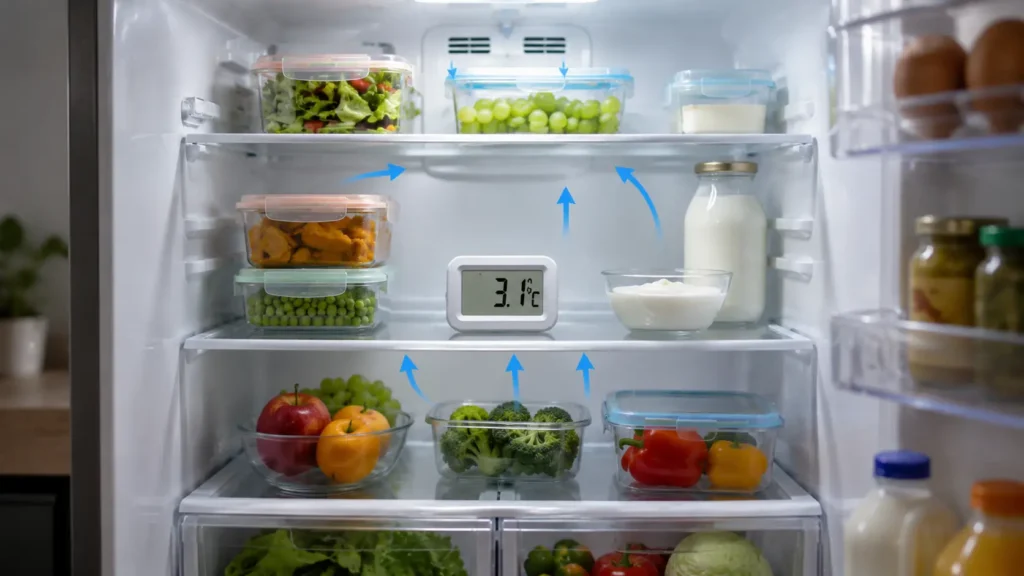
Correct refrigerator temperature is important, but proper food storage practices are equally necessary.
1. Use an Appliance Thermometer
Thermostat dials and control panels do not always show the actual temperature inside the refrigerator.An appliance thermometer provides a direct measurement and helps identify temperature problems.
2. Avoid Overloading the Refrigerator
Cold air needs enough space to circulate.Packing shelves too tightly can block airflow and create uneven temperatures. Leave some space between containers and keep cold-air vents clear.
3. Refrigerate Perishable Food Promptly
Cooked food, leftovers, dairy products, meat, seafood, and other perishable foods should not remain at room temperature for long periods.Follow recommended food safety time limits and refrigerate perishables promptly.
4. Store Highly Perishable Foods Away From the Door
The refrigerator door experiences greater temperature fluctuations because it is exposed to room air whenever the appliance is opened.Store highly perishable foods on interior shelves instead.
5. Separate Raw and Ready-to-Eat Foods
Keep raw meat, poultry, and seafood in sealed, leak-proof containers.Store them below cooked foods and ready-to-eat items to reduce the risk of cross-contamination.
6. Check the Refrigerator Door Seal
Inspect and clean the rubber gasket periodically.Replace damaged seals that prevent the refrigerator door from closing properly.
7. Store Fruits and Vegetables Properly
Avoid storing excessively wet produce for long periods.Use crisper drawers appropriately and follow storage recommendations for individual fruits and vegetables.
Where Should You Place a Refrigerator Thermometer ?
The middle shelf is generally a practical starting point for refrigerator thermometer placement.Keep the thermometer away from refrigerator walls, direct cold-air vents, and food containers that could affect the reading.Close the refrigerator door and allow sufficient time for the temperature to stabilize before checking the result.
For a better understanding of refrigerator performance, check the temperature at different times or move the thermometer between different areas.Large temperature differences may indicate blocked airflow, overloading, poor door sealing, or uneven cooling.
What to Do If Your Refrigerator Temperature Is Above 4°C
If the refrigerator consistently remains above 4°C, do not immediately assume that the appliance needs repair.Check the following:
- Incorrect thermostat setting.
- Blocked cold-air vents.
- Overloaded shelves.
- Frequent or prolonged door opening.
- Dirty or damaged door gasket.
- Poor ventilation around the refrigerator.
“Take care of your body. It’s the only place you have to live.”
Jim Rohn
Correct one possible issue at a time, allow the appliance enough time to stabilize, and check the thermometer again.If the refrigerator still cannot maintain a safe temperature, professional inspection may be necessary.
Freezer Temperature During Monsoon
The recommended freezer temperature does not need to change during monsoon.Keep the freezer at -18°C (0°F).Setting the freezer significantly colder than necessary generally provides no additional food safety benefit for properly frozen food and may increase electricity consumption.Instead of repeatedly adjusting freezer controls according to outside weather, verify that the freezer maintains its recommended temperature.
How to Reduce Refrigerator Electricity Consumption During Monsoon
Using the coldest refrigerator setting does not automatically improve food safety.Once the refrigerator is maintaining a safe internal temperature, unnecessary overcooling may increase electricity consumption.To improve efficiency:
- Maintain recommended refrigerator and freezer temperatures.
- Avoid unnecessary or prolonged door opening.
- Keep the door gasket clean and properly sealed.
- Provide adequate ventilation around the refrigerator.
- Avoid placing steaming-hot food directly inside.
- Divide large quantities of food into smaller, shallow containers for faster cooling.
- Keep the refrigerator reasonably full without blocking airflow.
- Clean accessible condenser coils when recommended by the manufacturer.
The goal is to maintain food safety without unnecessary energy consumption.
Common Refrigerator Mistakes to Avoid During Monsoon
Avoid these common mistakes:
- Changing the thermostat whenever outside weather changes.
- Assuming one dial number works for every refrigerator.
- Running the refrigerator at maximum cooling without checking the actual temperature.
- Keeping the refrigerator consistently above the recommended safe temperature.
- Blocking cold-air vents with food containers.
- Overloading shelves and preventing proper air circulation.
- Storing highly perishable foods on the refrigerator door.
- Storing raw meat above cooked or ready-to-eat food.
- Ignoring a dirty or damaged door gasket.
- Relying only on thermostat settings without verifying the actual temperature.
When Should You Call a Refrigerator Technician ?
Start by checking the thermostat setting, blocked vents, food loading, door gasket, ventilation, and thermometer reading.
Consider contacting a qualified refrigerator technician if:
- The refrigerator consistently remains above 4°C despite correct settings and normal use.
- The compressor runs continuously without maintaining a safe temperature.
- Major temperature fluctuations repeatedly occur.
- Excessive frost or ice keeps returning.
- Water leakage continues after basic troubleshooting.
- Unusual noises occur along with poor cooling performance.
- The refrigerator door gasket cannot seal properly.
If the appliance cannot maintain a safe temperature, move perishable foods to another refrigerator or suitable cold storage.
The best refrigerator temperature during monsoon is around 3°C to 4°C (37°F to 40°F) for practical household use, while ensuring the refrigerator remains at or below 4°C (40°F). The freezer should remain at -18°C (0°F).You generally do not need a special refrigerator setting for the rainy season.The biggest mistake is repeatedly adjusting the thermostat according to rain, humidity, or outside temperature without checking the actual temperature inside the refrigerator.
Use an appliance thermometer, keep cold-air vents clear, avoid overloading shelves, limit unnecessary door opening, inspect the door gasket, separate raw and ready-to-eat foods, and adjust the controls only when temperature readings indicate that a change is necessary.Maintaining a stable refrigerator temperature during monsoon helps protect food quality, support food safety, and avoid unnecessary electricity consumption.
Frequently Asked Questions
What is the best refrigerator temperature during monsoon years?
The best refrigerator temperature during monsoon is around 3°C to 4°C (37°F to 40°F), while ensuring the refrigerator remains at or below 4°C (40°F). Keep the freezer at -18°C (0°F).
Should refrigerator temperature be changed during monsoon ?
You generally do not need to change the target temperature simply because monsoon has started. Check the actual internal temperature and adjust the thermostat only when necessary.
What number should my fridge be set at from 1 to 5 during monsoon ?
There is no universal dial number because thermostat scales differ between refrigerator brands and models. Check the manufacturer’s instructions and use an appliance thermometer to verify the actual temperature.
Is 5°C too warm for a refrigerator?
The FDA recommends keeping refrigerators at or below 4°C (40°F). If your refrigerator consistently reads 5°C, adjusting it slightly colder provides a better safety margin under this guidance.
Is 2°C too cold for a refrigerator ?
A refrigerator temperature of 2°C is generally within a safe refrigeration range. However, sensitive produce stored near cold-air vents or colder areas may experience chilling injury or accidental freezing.
Why is there water inside my fridge during monsoon ?
Warm, humid air entering the refrigerator can cause condensation. Frequent door opening, damaged door seals, blocked drainage, improper food storage, or cooling problems may also contribute to excess moisture.
Should I use an appliance thermometer in my refrigerator ?
Yes. An appliance thermometer helps verify the actual internal temperature instead of relying only on thermostat dial numbers or control settings.
How long should I wait after adjusting the refrigerator temperature ?
Temperature stabilization time varies by refrigerator model, food load, room conditions, and door-opening frequency. Follow the manufacturer’s instructions and avoid repeated adjustments before the appliance has had enough time to stabilize.