
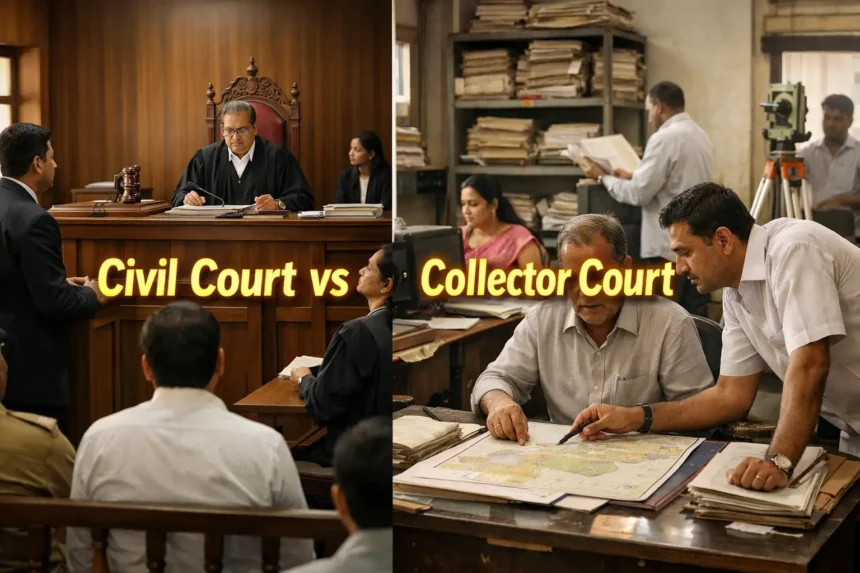
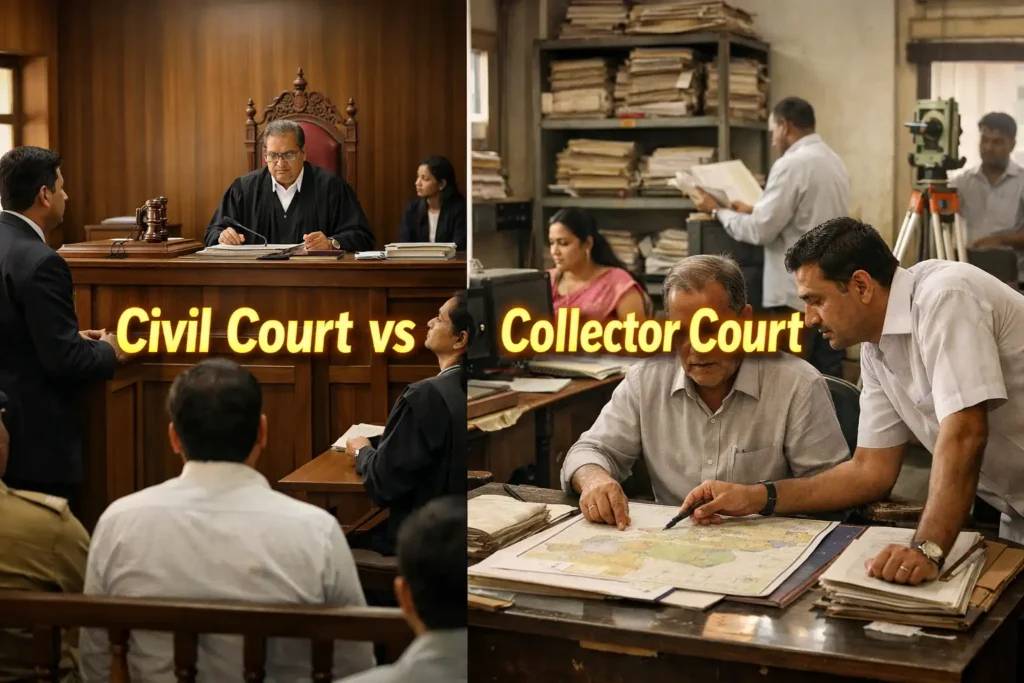
I n India, people often hear about Civil Court and Collector Court while dealing with land disputes, property matters, or government-related cases. However, many citizens are unsure about the real difference between these two courts. This confusion can lead to filing cases in the wrong forum, unnecessary delays, and avoidable legal expenses.
- What Is a Civil Court?
- What Is a Collector Court?
- Key Difference Between Civil Court and Collector Court
- Types of Cases Handled by Civil Court
- Types of Cases Handled by Collector Court
- Jurisdiction and Legal Authority
- Appeal Process in Civil Court vs Collector Court
- Which Court Should You Approach?
- Why This Difference Matters in 2026
- Official Source for Revenue and Judicial Structure
In 2026, with increased legal awareness and digitization of records, understanding the difference between Civil Court and Collector Court has become more important than ever. This blog explains their jurisdiction, powers, types of cases, and appeal process in clear and simple language so that common citizens can take informed legal decisions.
What Is a Civil Court?
A Civil Court is a judicial body that deals with disputes between individuals or organizations where criminal liability is not involved. These courts handle matters related to property ownership, contracts, family disputes, recovery of money, and civil rights.
Civil Courts operate under the judicial system and are presided over by judges appointed through the judiciary. Their primary objective is to provide legal remedies such as compensation, injunctions, or declarations of rights.
In most cases, disputes related to ownership, possession, or civil agreements are filed in Civil Courts.
What Is a Collector Court?
A Collector Court, also known as a Revenue Court, functions under the district administration and is headed by the District Collector or an officer authorized by them. These courts mainly deal with land revenue and administrative matters.
Collector Courts are not part of the regular judiciary. Instead, they function under revenue laws and government regulations. Their role is administrative as well as quasi-judicial in nature.Cases related to land records, mutation, partition of agricultural land, revenue recovery, and government land disputes usually fall under Collector Court jurisdiction.
Key Difference Between Civil Court and Collector Court
The main difference between Civil Court and Collector Court lies in their nature and authority. Civil Courts are judicial bodies with wide powers to adjudicate civil disputes and grant reliefs. Collector Courts, on the other hand, focus on revenue administration and land-related matters governed by specific statutes.
Civil Court judges act independently under the judiciary, while Collector Courts operate under the executive branch of the government. This distinction affects how cases are heard, decided, and appealed.
Types of Cases Handled by Civil Court
Civil Courts handle a wide range of disputes that affect personal and property rights. These include property ownership disputes, injunction suits, partition suits among family members, contract breaches, and recovery of money.Family-related matters like divorce, maintenance, and guardianship are also handled by designated civil or family courts. In 2026, many civil cases are being managed through digital filing systems to reduce delays.
Types of Cases Handled by Collector Court
Collector Courts primarily deal with land revenue cases. These include mutation of land records, correction of revenue entries, demarcation of land, eviction from government land, and recovery of dues as arrears of land revenue. In rural and semi-urban areas, most land-related administrative disputes are first taken to the Collector Court. Their decisions play a crucial role in maintaining official land records.
Jurisdiction and Legal Authority
Civil Courts have broader jurisdiction and can hear cases unless explicitly barred by law. Collector Courts have limited jurisdiction, restricted to matters defined under revenue laws. In many situations, revenue authorities decide administrative aspects of land, while ownership disputes must be resolved by Civil Courts. Understanding this separation prevents jurisdictional errors.
Also read this : New Criminal Laws 2026 Explained: BNS & BNSS Changes Every Citizen Must Know
Appeal Process in Civil Court vs Collector Court
Appeals from Civil Court decisions usually go to higher judicial courts, such as District Court or High Court, depending on the case value and nature.
In contrast, appeals against Collector Court orders typically go to higher revenue authorities or special tribunals before reaching the High Court. The appeal structure is different because Collector Courts operate under administrative law.
Which Court Should You Approach?
Choosing the correct court depends on the nature of the dispute. If the issue involves ownership, legal rights, or civil remedies, a Civil Court is the right forum. If the matter concerns land records, mutation, or revenue administration, a Collector Court is appropriate.
Consulting a legal expert before filing a case helps avoid delays and procedural complications.
Why This Difference Matters in 2026
With increasing land transactions and property disputes, filing cases in the correct forum saves time, money, and effort. In 2026, courts emphasize jurisdictional clarity to reduce case backlog and misuse of legal processes.
Awareness of the difference between Civil Court and Collector Court empowers citizens to navigate the legal system more effectively.
Also read : FIR, Chargesheet & Court Process Explained Simply: A Legal Guide for Citizens in 2026
Official Source for Revenue and Judicial Structure
For authoritative information on revenue administration and legal structure, citizens can refer to official government resources such as the Ministry of Law and Justice portal: https://www.legislative.gov.in
The difference between Civil Court and Collector Court lies in their purpose, powers, and jurisdiction. Civil Courts protect individual legal rights, while Collector Courts manage land revenue and administrative matters.
Understanding this distinction is essential for anyone dealing with property or legal disputes in India. In 2026, informed legal choices lead to faster justice and fewer complications.